
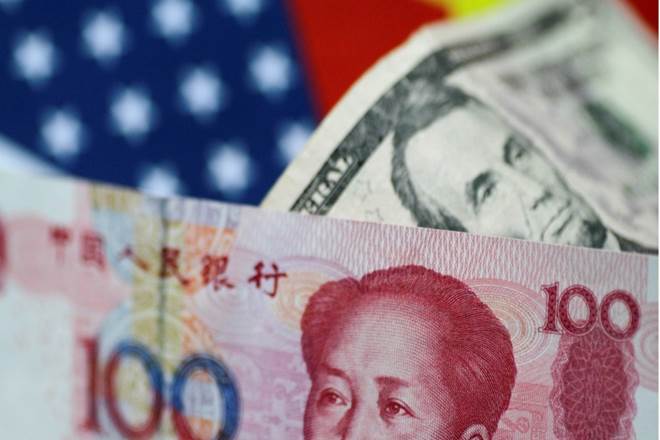
The Chinese yuan continued its strong appreciation trend, closing at 6.8597 per US dollar on April 7, 2026, marking a year-long upward trajectory from around 7.3 in April 2025. Despite recent U.S. dollar strength driven by geopolitical tensions and rising oil prices, the yuan has remained resilient, strengthening about 1.4% over the past month. China’s historically high current account surplus provides structural support for the currency.
Key Takeaways
- Sustained Yuan Appreciation: The yuan has continued a year-long appreciation trend, strengthening from ~7.3 per USD in April 2025 to near 6.86 per USD as of April 7, 2026, representing an overall gain of ~6%.
- Resilient Amid Dollar Strength: Despite a stronger U.S. dollar driven by geopolitical tensions and rising oil prices, the yuan has maintained its upward trajectory.
- Structural Support from China’s Current Account: China’s historically high current account surplus ($735 billion, 3.7% of GDP) underpins medium- to long-term RMB strength, though market translation of this surplus remains a key factor.
- Policy Implications: Geopolitical tensions and inflationary pressures may prompt central banks to adopt hawkish stances or intervene in FX markets, while China’s currency trajectory will hinge on trade surplus conversion into actual FX market flows.
Full Report
The Chinese yuan experienced a rapid appreciation on first trading day after the Qingming Festival holiday.
As of 16:30 on April 7, 2026, the onshore yuan closed the day trading at 6.8597 per US dollar, strengthening by 206 pips from the previous trading day.
This round of yuan appreciation has lasted a full year. Since April 2025, the currency has strengthened from around 7.3 per US dollar to its current level near 6.86. Overall, the yuan has strengthened by roughly 6% during the period. Its resilience has become even more evident in the past month: the yuan has not only withstood the headwinds of a stronger US dollar but has also appreciated broadly against other non-US dollar currencies.
After the outbreak of the US-Iran conflict in late February, global oil supply was severely disrupted, causing oil prices to surge and global inflation expectations to spike. This also led to a sudden cooling of the market’s expectations for a Federal Reserve rate cut, driving the U.S. dollar index sharply higher, briefly recovering above the 100 mark within the past month.
Since March, the U.S. dollar index has climbed from roughly 97 to 99, a gain of over 2%. Despite the dollar’s strength, the yuan bucked the trend, strengthening by about 1.4% over the period.
During the period, the yuan also strengthened broadly against a basket of currencies. As of April 3, the CFETS RMB Index stood at 100.84, up 2.3% from the end of February. This index, based on a basket of 25 currencies weighted by their trade volumes with China, provides a comprehensive measure of the renminbi’s performance against multiple foreign currencies.
The current geopolitical conflict is exerting a direct global impact mainly through disruptions in oil supply, placing greater pressure on the currencies of countries that are more reliant on Middle Eastern oil imports.
Barclays noted that currencies of net energy-importing countries are vulnerable, as sustained high oil and LNG prices could further weaken their trade balances. Asian economies such as Thailand, South Korea, and the Philippines are particularly exposed, while Chile, South Africa, and several Central and Eastern European nations also face notable risks.
Since the onset of the conflict, Asian currencies have diverged in performance. The South Korean won has weakened by nearly 4% against the U.S. dollar, while the Thai baht has fallen close to 5% against the dollar.
“So far, net oil and LNG-importing countries have underperformed slightly, but the broader foreign exchange response among emerging markets has been limited. This mirrors the pattern observed during the Russia-Ukraine conflict, when currencies also took time to gauge the persistence of oil shocks,” said Barclays.
Barclays noted that if the conflict persists, rising inflationary pressures or a deteriorating current account could further heighten depreciation risks for affected currencies. “Central banks may respond with more hawkish rhetoric or intervene in foreign exchange markets to support their currencies and prevent new sources of inflationary pressure from emerging.”
From a medium- to long-term perspective, China’s current account surplus remains at historically high levels. By the end of 2025, the surplus reached $735 billion, equivalent to 3.7% of GDP—up 1.5 percentage points from the end of 2024 and the highest level since 2011. This strong external position provides a solid underpinning for the renminbi’s exchange rate.
However, Li Chao, Chief Economist at Zheshang Securities, emphasized that the size of the surplus alone does not determine exchange rate trends; what matters is how the surplus translates into actual supply and demand in the foreign exchange market. He noted that the realization of the renminbi’s medium- to long-term appreciation will depend on whether the settlement rate, repatriation rate, and conversion rate of the goods trade surplus can increase in tandem.