
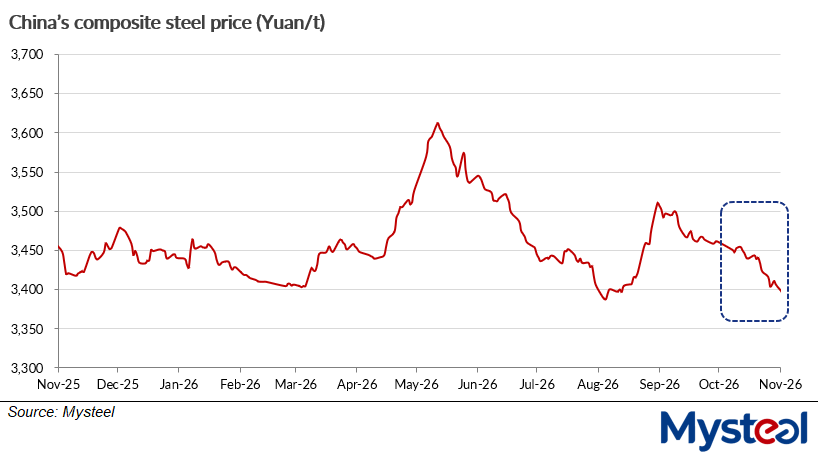
China’s steel prices are expected to slip further in November, following a 1.3% month-on-month drop in October to an average composite price of Yuan 3,432/t (about $515/t) including VAT. The main pressure comes from falling raw material costs, as coking coal and coke prices are likely to decline with coal supply stabilizing. Seasonal cooling in northern China is also curbing construction steel demand. Meanwhile, supply is adjusting only slowly: hot metal output at 247 tracked blast furnace mills fell just 0.8% over the month, even though only about 11% of them are profitable. This persistent mismatch is feeding oversupply concerns and is likely to push mills and distributors to accept lower prices. The decline is expected to be modest, however, as inventories of five major steel products across 35 cities are low at 14 million tonnes and faster policy implementation and major infrastructure projects should partly offset the seasonal slowdown in demand.
Chinese steel prices are expected to come under further pressure in November from falling raw material costs and the persisting mismatch between steel supply and demand, according to Mysteel’s chief analyst Wang Jianhua in his latest monthly outlook.
October saw domestic steel prices move lower, with the country’s composite steel price averaging Yuan 3,432/tonne ($515/t) including the 13% VAT, lower by 1.3% from the average price in September, according to Mysteel’s assessment.
Looking to November, the most immediate pressure comes from raw materials, Wang pointed out. With the central government signaling its commitment to stabilizing coal supply, and some coal mines in northern China gradually resuming production, domestic prices of coking coal and coke may decline further this month, he explained.
During the last week of October, the average capacity utilization rate among the 523 coking coal mining companies nationwide had increased to 71.8%, higher by 4.2 percentage points from a month earlier, according to Mysteel’s tracking.
Over October, China’s national composite coking coal spot price averaged Yuan 2,037/t including the 13% VAT, significantly lower by 8.9% from the previous month’s average price, Mysteel’s assessed.
Entering November, domestic demand for construction steel is contracting as falling daytime temperatures in northern China are prompting building contractors to gradually wind down activity, Wang remarked. Meanwhile, the decline in supply has been relatively slow, which will place further pressure on prices, he warned.
For example, combined hot metal production among the 247 blast furnace (BF) steelmakers under Mysteel’s tracking averaged 2.32 million tonnes/day in the last week of October, lower by just 0.8% from a month earlier. At the same time, only around 11% of these 247 mills – about 28 firms – could make some profits on selling their steel.
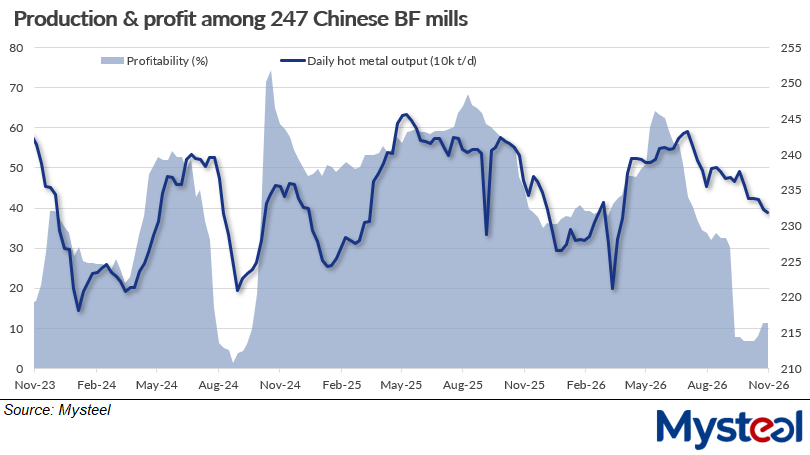
The fact that steel mills have maintained steady production despite near-blanket losses has heightened market concerns about possible oversupply, and this sentiment is likely to persuade mills and distributors to accept lower prices this month, Wang emphasized.
Nevertheless, the downward adjustment in steel prices is expected to be modest, as steel inventories in the market remain at low levels and should provide steady support, Wang noted.
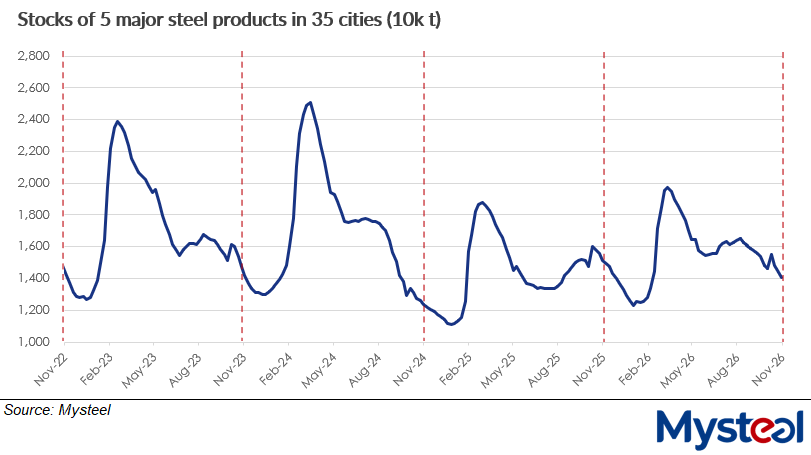
By the end of October, inventories of the five major carbon steel products held by steelmakers and traders in 35 domestic cities under Mysteel’s tracking had fallen for three weeks straight to total 14 million tonnes, down 4% on month and lower by 7.2% from the year-ago level.
On the macroeconomic front, stronger policy implementation will also help cushion prices on the downside. “November will mark a window in which existing policies are implemented at a faster pace while incremental policies are gradually rolled out,” Wang observed.
Already this year, ground has been broken on major standalone projects including the national water network, new-type power grids, urban underground pipe networks and computing networks, he explained, adding that work on these projects should partially offset the seasonal downturn in steel demand in some regions.